SEALER BLISTERS AND BUBBLES
WHY DO CONCRETE SEALER BLISTERS AND BUBBLES FORM?
Most sealers with less than 100% solids either drys or cures when the liquid portion of the sealer (water, xylene, acetone) evaporates after it helps transport the solids portion onto the surface of the concrete.
Once the liquid portion evaporates the solid portion gets hard forming a film that helps protect the concrete.
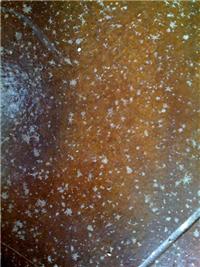
During this curing process air and some other gases need to escape. If the sealer dries too fast or to slow due to extreme hot or cold temperatures there is the potential for some of the gases to get trapped causing (blisters).
Very windy and dry conditions could also dry out the surface of the sealer causing it to crust over and potentially trap some air causing (bubbles).
Ideal temperatures for sealing concrete fall between 50 - 80 degrees, read the manufactures specifications for best results.
HOW CAN I FIX THESE SEALER BLISTERS AND BUBBLES?
To resolve this problem for solvent based sealers you can try spraying or rolling on some xylene or acetone.
If the sealer was applied too thick you might need to back roll it after spraying. This will re-wet the sealer and help it lay out again releasing the air and gas bubbles.
This same solution will sometimes work with water based sealers just try it on a small area first.
Sometimes reapplying the same sealer will fix the concrete blisters and bubbles, again try this on a small area first.
No need to waste all that sealer or create more problems if it doesn't work.
As a last resort the sealer can be removed using chemical strippers, then scrubbing and washing the surface of the concrete.
Reapply the sealer with a thin coat only after watching the weather for the ideal temperature conditions.
Learn about other related concrete sealer topics:
CONCRETE SEALER AND CONDENSATION PROBLEMS
CONCRETE SURFACE TEMPERATURE CAN CAUSE SEALER PROBLEMS
DEICING SALTS AND CONCRETE SEALER PROBLEMS
SEALER SURFACE PREPARATION BEFORE SEALING
IS THERE A TINTED SEALER I CAN USE?
WHAT KIND OF SEALER APPLICATOR SHOULD I USE?
Return from Concrete Sealer Blisters and Bubbles to Concrete Sealer
Return from Concrete Sealer Blisters and Bubbles to Everything About Concrete Home Page
Hi, I am Mike Day, owner of Day’s Concrete Floors, Inc. in Maine. I've been working with concrete for 40 years now, and this website is where I can share with you all the knowledge, wisdom and expertise I've gained from installing all kinds of stamped concrete, concrete floors, concrete overlays, concrete slabs and also repairing & fixing cracked or spalled concrete.
There’s a lot to cover, so if you have any questions, contact me!
LEARN HOW TO EPOXY A GARAGE FLOOR
FREE CONCRETE FINISHING TRAINING TUTORIAL VIDEO
Recent Articles
-
Don't get over charged! Here's my concrete slab cost for 2024
 I'm a concrete contractor that will tell you how much a concrete slab will cost. These are my actual prices I charge for 2024 when I quote my customers.
 -
The tools I use to do concrete work - Use the same tools I do.
 Learn about and purchase the tools I use to do concrete floors, stamping, staining, polishing, countertops, sawing and a whole lot more.
 -
How To Make Concrete Without A Mixer - Mixing Concrete by Hand
 Learn how to make concrete manually without a mixer. Explore simple steps and tips to achieve the right consistency and strength for your construction project.
 -
What are the Correct Concrete Mixing Ratios - Ratio Chart
 The proper concrete mixing ratios are 1:2:3, 1:3:3, 1:2:4 for cement, sand, and stone. Mixing ratios are based on what psi concrete you need. Mixing ratio chart
 -
Concrete Mix Ratios For 3000, 3500, 4000, and 4500 psi concrete
 Learn the precise mix ratios for concrete strengths of 3000, 3500, and 4000 psi to ensure durability and stability in concrete construction.