CONCRETE WEDGE ANCHORS
How to anchor things to concrete and masonry using a wedge anchor
Concrete wedge anchors are used to fasten or secure many different kinds of things to concrete and masonry.
Wedge anchors, also known as expansion bolts and expansion anchors, secure themselves to concrete using a mechanical wedging effect at the end of the anchor.
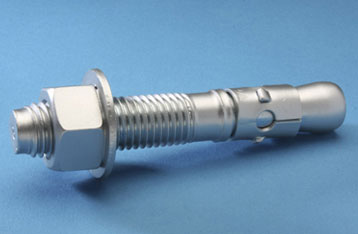
Here's a typical concrete wedge anchor bolt
You can buy your concrete wedge anchors right on Amazon
Here are some of the different size wedge anchors:
- 1/2" x 5-1/2" Wedge Anchor Zinc plated
- 1/2" x 7" Wedge Anchor Zinc plated
- 1/2" x 4-1/4" Wedge Anchor Zinc plated
- 3/4" x 5-1/2" Wedge Anchor Zinc plated
- 1/2" x 8" Rotary Hammer Drill Bit
- 3/4" x 8" Rotary Hammer Drill Bit
Disclaimer: If you purchase a wedge anchor or drill bit from amazon within 24 hours of using one of my links, I well receive a small commission from the sale. Thank you for supporting this site!!
|
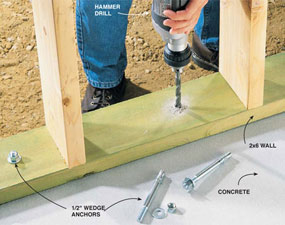
After a hole is drilled into the concrete, the Hilti wedge anchor is tapped into the hole. The tightening of the bolt results in a wedge being driven up against a sleeve which jams the end of the bolt into the concrete, providing the strength. Many different manufactures provide a variation to the wedging action for you to choose from, depending on the condition of the concrete and the type of load you are securing to it. |
 |
Concrete Wedge Anchor - Installation:
1. Drill a hole in the concrete using a hammer drill and a carbide tipped masonry drill bit the same diameter as the wedge anchor. If the fixture being fastened is in place and being used as a template to locate the hole for the wedge anchor, the mounting hole in the fixture should afford clearance for the universal wedge clip on the anchor stud.
2. Clear the hole of all debris, then place the wedge anchor through the hole in the fixture or directly into the concrete, and hammer it in to the drilled hole, ensuring that it is installed to the desired depth.
3.
Turn the nut by hand until the unit is "snugged up". Tighten the nut
with a torque wrench to ensure it is tightened to the required torque
value.
Concrete Wedge Anchor - Anchor Length:
To determine the minimum anchor length required, simply add minimum embedment, plus fixture thickness, plus the thickness of the nut and washer.
The
wedge anchor requires no maximum hole depth. The depth of the hole in
the concrete should be the length of the wedge anchor minus the
thickness of the material being fastened. This will result in some extra
depth to accommodate a minor amount of concrete dust which may not be
able to be cleaned out of the hole.
Concrete Wedge Anchor - Anchor Spacing:
The forces on a wedge anchor are transferred to the material in which it is installed. If the anchors are installed too close together, it can cause an interaction of the forces, thus reducing the holding power of the anchors.
As a rule of thumb, the concrete anchor industry has established a minimum standard of ten (10) anchor diameters for spacing between anchors and five (5) anchor diameters from an unsupported edge. When vibration or sudden impact are part of the load condition anchor spacing should be increased.
Check out the video below to learn how to install concrete wedge anchors.

Hi, I am Mike Day, owner of Day’s Concrete Floors, Inc. in Maine. I've been working with concrete for 40 years now, and this website is where I can share with you all the knowledge, wisdom and expertise I've gained from installing all kinds of stamped concrete, concrete floors, concrete overlays, concrete slabs and also repairing & fixing cracked or spalled concrete.
There’s a lot to cover, so if you have any questions, contact me!
LEARN HOW TO EPOXY A GARAGE FLOOR

FREE CONCRETE FINISHING TRAINING TUTORIAL VIDEO
Recent Articles
-
Don't get over charged! Here's my concrete slab cost for 2024
 I'm a concrete contractor that will tell you how much a concrete slab will cost. These are my actual prices I charge for 2024 when I quote my customers.
 -
The tools I use to do concrete work - Use the same tools I do.
 Learn about and purchase the tools I use to do concrete floors, stamping, staining, polishing, countertops, sawing and a whole lot more.
 -
How To Make Concrete Without A Mixer - Mixing Concrete by Hand
 Learn how to make concrete manually without a mixer. Explore simple steps and tips to achieve the right consistency and strength for your construction project.
 -
What are the Correct Concrete Mixing Ratios - Ratio Chart
 The proper concrete mixing ratios are 1:2:3, 1:3:3, 1:2:4 for cement, sand, and stone. Mixing ratios are based on what psi concrete you need. Mixing ratio chart
 -
Concrete Mix Ratios For 3000, 3500, 4000, and 4500 psi concrete
 Learn the precise mix ratios for concrete strengths of 3000, 3500, and 4000 psi to ensure durability and stability in concrete construction.