CONCRETE CONTROL JOINTS
PREVENTING CRACKS IN CONCRETE
Concrete control joints are used to minimize and possibly prevent random cracking in concrete slabs and floors. Here you will learn how to properly install and where to place control joints in all types of concrete flatwork to reduce the chances of cracking.
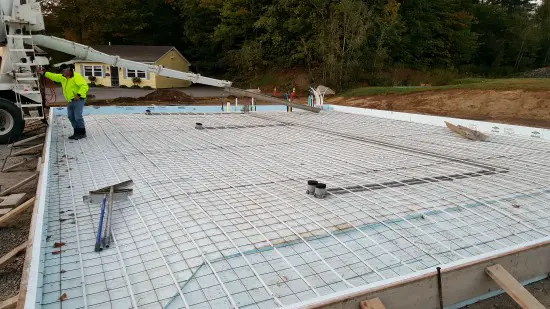
Below is a diagram of a concrete floor showing you the three types of control joints for a concrete floor; isolation joints, contraction joints, and construction joints. For a more detailed explanation, follow the links at the bottom of the page.
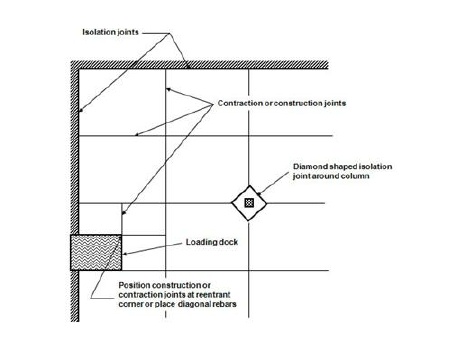
Concrete is used in construction for its hardness and very high compressive strength. Not being a flexible material it doesn't stretch or bend without cracking. Concrete does move though, it shrinks and expands. Buildings and other structures also move, contributing to cracking in slabs and floors. If the concrete is tied to a structure or itself and tries to move, we get what's called restraint. This restraint causes tensile forces in the concrete and in most cases cracking will occur.
Concrete needs to be able to freely shrink as it dries or to expand and contract with temperature changes to help minimize any random cracking.
Properly placed control joints will allow concrete to shrink, expand, and contract, reducing the tendency for it to crack.
I've
been in the concrete floor business for over 30 years. I've installed
thousands of lineal feet of control joints in my concrete floors. Most of the time we saw the joints using an early entry soff-cut saw. This method allows us to saw the relief cut very soon after we are done troweling. A big advantage when you're trying to prevent cracks in concrete floors.
I feel it's very important, if you want to minimize cracking, to take the time and plan in advance where and what materials you are going to use to install your control joints.
I still see concrete contractors skip this step and leave customers with cracks in their floors that are ugly and unnecessary.
In concrete slabs and floors there are three types of control joints:
1. Concrete expansion joints also referred to as concrete isolation joints.
2. Concrete contraction joints
3. Concrete Construction joints
Read about each one to learn how they are used to help control random cracking in concrete slabs, floors, sidewalks, pool decks and driveways.
You might also find epoxy concrete repair helpful if you want to know how to fix or repair a crack in a concrete floor.
You may also want to check out my video on how to caulk a concrete expansion joint.

Hi, I am Mike Day, owner of Day’s Concrete Floors, Inc. in Maine. I've been working with concrete for 40 years now, and this website is where I can share with you all the knowledge, wisdom and expertise I've gained from installing all kinds of stamped concrete, concrete floors, concrete overlays, concrete slabs and also repairing & fixing cracked or spalled concrete.
There’s a lot to cover, so if you have any questions, contact me!
LEARN HOW TO EPOXY A GARAGE FLOOR

FREE CONCRETE FINISHING TRAINING TUTORIAL VIDEO
Recent Articles
-
Don't get over charged! Here's my concrete slab cost for 2024
 I'm a concrete contractor that will tell you how much a concrete slab will cost. These are my actual prices I charge for 2024 when I quote my customers.
 -
The tools I use to do concrete work - Use the same tools I do.
 Learn about and purchase the tools I use to do concrete floors, stamping, staining, polishing, countertops, sawing and a whole lot more.
 -
How To Make Concrete Without A Mixer - Mixing Concrete by Hand
 Learn how to make concrete manually without a mixer. Explore simple steps and tips to achieve the right consistency and strength for your construction project.
 -
What are the Correct Concrete Mixing Ratios - Ratio Chart
 The proper concrete mixing ratios are 1:2:3, 1:3:3, 1:2:4 for cement, sand, and stone. Mixing ratios are based on what psi concrete you need. Mixing ratio chart
 -
Concrete Mix Ratios For 3000, 3500, 4000, and 4500 psi concrete
 Learn the precise mix ratios for concrete strengths of 3000, 3500, and 4000 psi to ensure durability and stability in concrete construction.